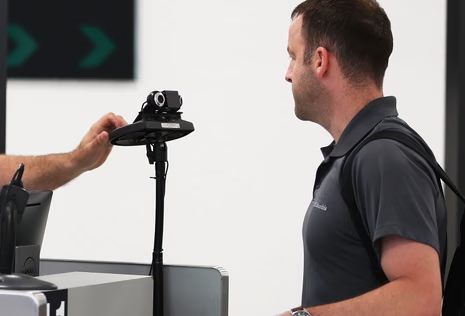
The U.S. government has announced a major expansion of facial recognition technology at airports, seaports, and land crossings to track the movement of non-citizens. The new regulation, set to take effect on December 26, marks one of the most significant steps yet in America’s effort to modernize border control and curb illegal immigration.
Under the rule, border authorities will require non-citizens to be photographed when entering or leaving the country. This includes not only international airports but also smaller land and maritime points of departure. The move expands a pilot program that began several years ago under U.S. Customs and Border Protection (CBP).
According to the official document published on Friday, CBP may also require the submission of additional biometric data, including fingerprints and DNA samples, as part of the expanded verification process. This aims to strengthen identity tracking and help identify visa overstays and passport fraud. These are issues that have long challenged federal immigration enforcement.
Why the U.S. Is Expanding Facial Recognition Systems
The government’s decision to expand facial recognition systems at U.S. borders reflects a renewed push to tighten immigration oversight. President Donald Trump has made border enforcement a key policy focus, emphasizing both physical border control and digital surveillance.
CBP officials argue that biometric verification offers a faster, more accurate, and less intrusive method of confirming identities. The system can match travelers’ live images with photos stored in government databases, such as visa applications or passport records.
In recent years, the Department of Homeland Security (DHS) has tested biometric exit systems to record departures. These tests revealed that automated facial matching can process passengers in seconds; much faster than manual passport checks. Authorities say the expansion will make it easier to detect visa overstayers, a group that accounts for nearly half of all people living in the U.S. illegally.
Combating Visa Overstays with Biometric Tracking
According to the Congressional Research Service, about 42% of the 11 million undocumented immigrants in the United States entered legally but overstayed their visas. Congress first mandated an automated entry-exit system in 1996, but the technology and funding required for nationwide implementation were lacking.
Now, with advancements in facial recognition and biometric data processing, U.S. border agencies believe they can finally meet that decades-old goal.
CBP projects that a full biometric entry-exit tracking system can be deployed at all commercial airports and seaports within three to five years. Officials say the technology will make it harder for individuals to remain in the U.S. beyond the validity of their visas without detection.
For instance, once implemented, facial scans at departure gates will automatically flag passengers who fail to exit the country after their authorized stay. This will allow immigration authorities to take faster action on visa overstays whether through targeted enforcement, visa revocations, or future travel restrictions.
Read more about visa overstays
Expanding Use Across All Age Groups
The new regulation also removes age exemptions for certain travelers. Under previous rules, children under 14 and elderly travelers over 79 were not subject to biometric facial scans. The updated policy extends coverage to these groups, citing the need for complete and accurate data.
Officials say the change aligns with global trends, as several countries have introduced biometric identity checks for all age groups to close potential security gaps. By capturing data from a broader range of travelers, the U.S. hopes to create a more comprehensive database for verifying international movements.
However, the expansion has drawn concern from civil liberties groups, who warn that young children and older adults may face a higher risk of false matches or technical errors due to facial recognition’s varying accuracy across age demographics.
Privacy Concerns and Racial Bias Issues
While federal agencies emphasize efficiency and national security, civil rights advocates continue to raise alarms over privacy risks and algorithmic bias in facial recognition technology.
A 2024 report from the U.S. Commission on Civil Rights found that facial recognition systems were more likely to misidentify Black individuals and other minorities, especially in poor lighting or crowded settings.
Critics argue that such errors could lead to wrongful detentions, travel disruptions, or discrimination in border processing. They also question the long-term storage and use of biometric data, urging greater transparency and oversight.
The DHS maintains that its systems undergo regular testing and are compliant with federal privacy laws. It insists that all images collected are encrypted, stored securely, and deleted after verification unless flagged for enforcement purposes.
Nevertheless, watchdog organizations such as the Electronic Frontier Foundation (EFF) and American Civil Liberties Union (ACLU) continue to advocate for independent audits and stricter limitations on government biometric databases.
Implementation Timeline and Next Steps
U.S. Customs and Border Protection currently uses facial recognition technology for all commercial air entries, but exits are still limited to select airports. The new regulation paves the way for full deployment across air, sea, and land ports.
CBP says the expansion will proceed in phases, prioritizing high-traffic airports before extending to land border crossings with Mexico and Canada. Within three to five years, every major U.S. port of entry could use biometric verification as the standard procedure.
The technology’s rollout will also coincide with infrastructure upgrades and new partnerships between CBP, the Transportation Security Administration (TSA), and private airport operators. These agencies are expected to share data through integrated systems to ensure smoother passenger processing and reduce manual checks.
Balancing National Security and Civil Rights
The challenge for policymakers remains balancing national security needs with privacy protection. The growing reach of facial recognition surveillance raises questions about consent, data sharing, and the limits of government authority.
For immigration authorities, however, the benefits are substantial. Automated systems can verify millions of identities daily, prevent fraud, and streamline border management—tasks that would otherwise require extensive human labor.
Experts argue that the key lies in implementing strong oversight frameworks, including third-party audits, strict retention policies, and independent review boards. These measures can ensure that the system remains accurate, transparent, and fair while advancing security goals.
What the Expansion Means for Travelers and Immigrants
For most travelers, the new system will mean faster processing times and fewer manual document checks. A quick facial scan will verify a traveler’s identity against official databases, often completing the process in under five seconds.
For immigrants and visa holders, however, the system will play a critical role in ensuring compliance. Individuals who fail to exit the U.S. within the authorized period could be automatically flagged, affecting future visa applications or re-entry attempts.
The policy also signals a broader shift toward data-driven immigration enforcement, where algorithms and biometrics supplement traditional border control measures.
Travelers are advised to stay informed about facial recognition policies at U.S. ports of entry and understand their rights regarding data use and privacy.
A Transformative Step in Immigration Enforcement
The expansion of facial recognition technology underscores a transformation in how the U.S. manages immigration. It represents a move toward automated verification and real-time data analytics to track entries, exits, and visa compliance.
While the policy continues to face scrutiny from privacy advocates, federal officials maintain that it is a necessary step to modernize border management and close long-standing security gaps. The next few years will determine whether these tools can deliver accuracy and fairness while maintaining public trust.
Maple Crest Immigration Law Firm
If you are a visa holder, immigrant, or permanent resident concerned about how evolving border technologies may affect your travel or immigration status, Maple Crest Immigration Law Firm can help.
>Our team provides up-to-date legal guidance and expert representation to protect your rights and ensure full compliance with U.S. immigration laws.